
Brick cleaning for stained heritage buildings in Boldmere

A heritage building brick cleaning service in Wolverhampton should never rely on simply turning up the pressure. Some stains can be removed, but the method needs to suit the brick’s age, surface and condition.
It’s understandable to want to tackle discolouration quickly, especially when paint, graffiti, pollution, efflorescence, mortar marks or years of environmental build-up dull the brickwork. But heritage surfaces need care: forceful cleaning can affect their texture and character.
This guide explains which marks may be removed, why assessment matters and how cleaning methods are chosen for different bricks and stone. You’ll also learn when cleaning may be unsuitable and what to consider before arranging work, so you can make an informed decision about heritage brick cleaning in Wolverhampton and Sutton Coldfield.
Key Takeaways
Paint, graffiti, pollution marks, efflorescence and mortar residue may be removable, but the right approach depends on the brickwork and the stain. Historic bricks need careful assessment: aggressive cleaning can damage their surface and leave them more vulnerable to moisture. For conservation-area properties, consider the building’s historic character before planning cleaning or restoration work. Cleaning methods should suit the brick or stone, its condition and its sensitivity, rather than relying on one approach for every surface. Fragile stone and lime mortar call for particular care, so learn which methods can clean gently while preserving surface detail.What types of staining can be removed from brickwork?
Brick cleaning can target surface staining such as paint, graffiti, pollution deposits, efflorescence, mortar marks and long-term environmental build-up. Results depend on the stain, the brick’s condition and how deeply the deposit has entered the surface. A dark patch on one wall may need a different treatment from pale residue across several courses.
Carbon staining and pollution often appear as grey or black deposits, particularly on exposed elevations. Before cleaning, a professional distinguishes surface contamination from changes to the brick itself. A controlled assessment helps establish where deposits sit, whether they follow mortar joints and how the surrounding bricks respond. Removing surface pollution should not come at the cost of the brick’s texture.
Paint and coatings need particular care. Some can trap moisture and conceal problems beneath them, so removal is not simply a matter of stripping away colour. The process must account for the coating’s thickness and condition, as well as the brick’s porosity. Old paint may leave traces after the main layer lifts. A careful approach aims to reduce residue without scouring the underlying surface.
Graffiti and mortar marks need different treatments. Graffiti may sit on top of the brick, while mortar residue can cling to the face or collect along joints. A professional assesses the affected area, then chooses a treatment suited to the deposit and masonry. On heritage brick, aggressive abrasion can remove original surface detail along with the unwanted mark.
Efflorescence is the pale, powdery deposit sometimes seen on brickwork. It forms when moisture carries soluble salts towards the surface, where they remain as the wall dries. Cleaning may remove visible residue, but the moisture movement that caused it matters too. Repeated deposits can point to an ongoing source of damp, so cleaning alone may not resolve the underlying cause.
Algae, moss and lichen create different patterns. Green algae can spread across damp, shaded brick; moss may gather on ledges or in joints; lichen can attach firmly in small patches. Removal should suit both the growth and the brick beneath it. A professional considers whether brushing, treatment or controlled washing is appropriate, rather than applying the same force everywhere.
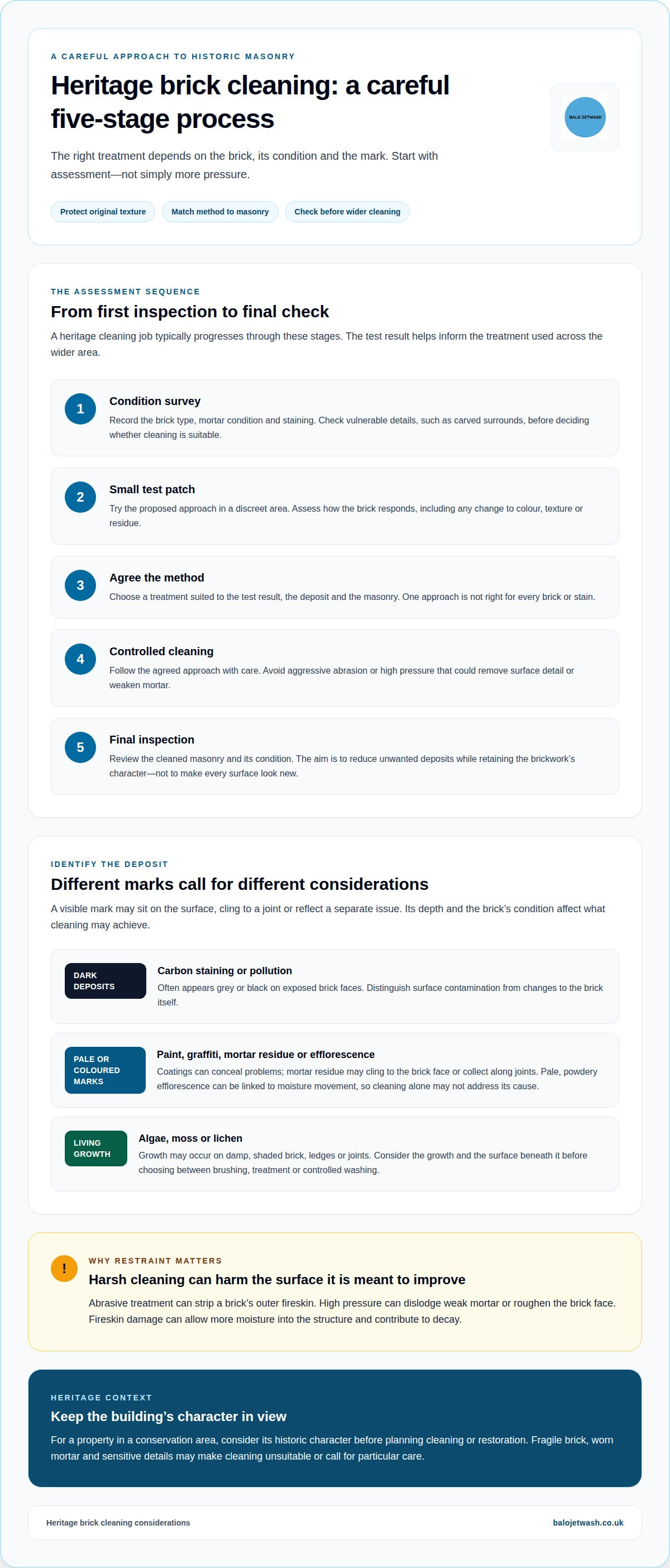
A useful first assessment separates staining into visible categories:
Dark deposits: carbon staining or pollution on exposed brick faces. Coloured or pale marks: paint, graffiti, mortar residue or efflorescence. Living growth: algae, moss or lichen in damp areas and joints.This distinction guides treatment and helps protect original brickwork. Some stains respond well to cleaning; others may have altered the surface or revealed a separate moisture issue. The aim is to reduce unwanted deposits while retaining the masonry’s character.
When should heritage brickwork cleaning be carried out by a professional?
Use a professional when historic bricks are fragile, mortar is worn or staining covers a large area. For properties in Sutton Coldfield, a heritage brick cleaning service should assess the masonry before choosing a treatment.
Historic brickwork cleaning
Cleaning historic or listed brickwork should begin with a condition assessment. The professional examines cracks, worn mortar, previous repairs and brick faces before proposing a method. These details show where cleaning could cause damage and help set suitable limits. Look for experience with comparable historic masonry and a plan that preserves original texture rather than aiming for a uniformly new appearance.
Which brick cleaning companies serve Sutton Coldfield? Exterior-cleaning businesses work in the area, but heritage projects need a method suited to historic masonry. Look for a provider who can explain how the brick and mortar are assessed before cleaning.
Low-impact cleaning approaches
Low-impact cleaning uses controlled methods to reduce risk to the façade. Abrasive treatment can remove the brick’s outer fireskin, while high pressure can dislodge weak mortar or roughen the brick face. According to the UK Government, damage to a brick’s fireskin can let more moisture enter the structure and contribute to decay. Soft, weathered masonry needs particular care.
What damage can abrasive or high-pressure cleaning cause? It can strip surface detail, erode mortar joints and increase moisture entry if the fireskin is damaged. These effects can change the building’s appearance and contribute to deterioration.
Contractor heritage experience checks
To assess heritage experience, review examples that show the masonry, the original problem and the cleaning approach. Ask for relevant references, evidence of insurance and examples of completed work. These checks help you understand whether the provider has handled delicate façades, rather than only modern hard surfaces.
How can you find independent reviews and before-and-after examples? Look at independent business profiles and project galleries with clear images of the same area before and after treatment. A useful example identifies the surface and method, rather than showing an unrelated cleaned wall.
Survey, test patch and full cleaning
An assessment records brick type, mortar condition, staining and vulnerable details such as carved surrounds. The professional then carries out a small test patch in a discreet area. Its result helps assess changes to colour, texture and residue before wider cleaning begins.
What steps are involved in a heritage cleaning job? The process typically moves from a condition survey to a test patch, an agreed method, controlled cleaning and a final inspection. The provider should explain how the wider treatment will follow the test result and how adjoining surfaces and joints will be protected.
Conservation-area property cleaning
Cleaning in a conservation area calls for a clear plan that considers the building’s setting and original features. For a property in Sutton Coldfield, identify its designation and the proposed work before arranging treatment.
Conservation-area property care
A specialist assessment should record the brickwork, mortar and features that contribute to the façade’s character. Decorative courses or original pointing, for example, may need a gentler approach than a modern repair. Tailor the washing method to each surface instead of applying one treatment across the whole exterior.
Consider adjoining materials too. A conservatory beside brickwork has glass, frames and seals that need different handling. Define which surfaces the cleaning will cover so the masonry method is not carried over to the conservatory.
Working with conservation officers
If the property has a heritage designation, discuss the proposed work with the relevant local planning authority before cleaning begins. A conservation officer can help identify features to retain, such as historic brick bonds, stone dressings or original mortar. Provide photographs of the affected elevation and describe the proposed method and test-patch location.
This keeps the discussion specific: the material, the area to be cleaned and the expected effect. A treatment on a brick wall, for example, may affect adjoining stone details differently, so describe each surface separately.
Listed building consent considerations
Does heritage brick cleaning in Sutton Coldfield require listed building consent? The answer depends on the property’s designation and the proposed work, so don’t assume conservation-area status alone determines the requirement. Contact the relevant local planning authority with the property details and a clear description of the cleaning method.
Explain whether the proposal covers brick faces, mortar joints, stone details or surfaces beside a conservatory. The scope and likely effect on historic features help the authority consider the specific work. Be precise, and wait for appropriate guidance before proceeding if consent may be needed.
Transport Scotland states: “For designated buildings, alterations affecting historic and architectural character require listed building or conservation area consent.” Frame cleaning proposals around their likely effect on the building’s historic and architectural character, rather than describing them only as a routine wash. Give the authority a precise account of the surfaces involved and how the chosen approach will treat them. If the work could alter character, seek a decision on applicable consent before arranging it. Keep the proposal consistent with the details already supplied, and check whether any change in scope also needs consideration.
Selecting cleaning methods for brick type and condition
The right technique depends on the brick, mortar, deposits and condition of each exterior. For a façade in Sutton Coldfield, the cleaning plan should address staining while protecting the original surface texture.
Matching methods to brick condition
A method suitable for hard, sound brick may be too forceful for soft or weathered masonry. Assessment should consider the brick face, mortar joints, previous repairs and areas exposed to persistent damp. Crumbling joints, for example, need a gentler approach than intact brick with a light surface deposit. These differences guide the choice of washing pressure, treatment and working distance.
How do low-pressure steam cleaning and chemical cleaning compare for historic brick? Steam uses controlled heat and moisture to loosen deposits, while chemical cleaning relies on a suitable treatment to break them down. Neither is right for every wall; the brick, stain and test-patch result should guide the choice.
This distinction matters because aggressive cleaning can damage the brick’s fireskin. According to the UK Government, damage to this outer layer can let more moisture enter the structure and contribute to decay. Preserving it is a practical priority, not just a matter of appearance.
Brick and render cleaning methods
Brick and render need separate methods, even when they meet on the same exterior. A brick wall may have open joints or a textured face, while render is a continuous coated surface. The cleaning professional should identify the materials first, then adapt the treatment and water control at their boundary. Using one setting across both could affect one surface more than the other.
Gentle nebulous water-spray cleaning is described as minimising moisture saturation. This can matter for porous, weathered masonry where excess water is a concern. The cleaning plan should still account for the deposit, drainage and nearby details, rather than treating the technique as a universal solution.
Ladderless access can help reach upper elevations without placing equipment against delicate brickwork. The access system also needs to let the operator control cleaning distance and direct water carefully. On a tall gable, those controls matter around mortar, window surrounds and projecting courses.
Methods for old buildings
For older buildings in Sutton Coldfield, choosing a suitable method starts with identifying the masonry and testing a small area. Controlled washing or a compatible treatment may suit one deposit, while a fragile surface may need a less intensive approach. The test patch shows whether the method alters colour, texture or mortar before work extends across the façade.
The method should respond to the stain too. Pollution on exposed brick, for example, may need a different treatment from biological growth in shaded joints. A specialist can tailor the technique to each area, then inspect the cleaned surface before continuing. This step-by-step approach helps avoid applying unnecessary force to original brickwork.
Good cleaning protects character, not just colour. A careful plan considers the whole exterior, including mortar and render, so the removal method suits each material and its condition.
Sensitive stone building cleaning
Stone needs a different exterior cleaning assessment from brick, particularly on historic buildings with worn faces, lime mortar or carved details. The stone type, weathering and deposits all influence the suitable method. Sandblasting and high-pressure washing can irreversibly damage fragile stone, lime mortar and historic renders. A careful plan therefore starts by identifying vulnerable areas, not by choosing equipment first.
On a façade combining brick and stone, each material may respond differently to the same treatment. A stone window surround beside brickwork, for example, may be softer or more weathered. The cleaning plan should define separate areas and methods, then use a test patch to assess the effect on each. This helps avoid treating a mixed exterior as one uniform surface.
Carved stone calls for particular care. Fine lettering, mouldings and sharp edges can lose definition if cleaning removes the outer surface. A suitable approach aims to remove atmospheric pollutants while retaining the stone’s patina and carved detail. For a carved doorway, the test area should include a representative section so the effect can be judged before wider work begins.
Chemical stone cleaning is not a standard treatment. The professional needs to match the product and process to the stone, the deposit and surrounding materials. The plan should explain where treatment will be applied, how residues will be managed and how adjoining brick or mortar will be protected. A small trial area helps show whether the treatment changes the stone’s appearance.
DOFF cleaning is another method to consider for sensitive stone, but its suitability depends on the surface and required result. Compare it with nebulous water-spray cleaning, described as suitable for porous, weathered stone. The choice should reflect the stone’s condition, the pollutant and the need to preserve its patina. No method should be selected by name alone.
Before work starts, a professional assessment can set out the treatment sequence:
Identify materials: distinguish brick, porous stone, lime mortar and historic render across the exterior. Record details: note weathered faces, joints, carvings and areas with atmospheric deposits. Trial the method: assess a representative patch before extending treatment across the façade. Inspect the finish: check pollutant removal alongside retained patina and carved definition.This process makes the cleaning decision specific to the building. On sensitive stone, preserving surface character matters as much as reducing visible contamination.
For any cleaning work, the aim should be to remove atmospheric pollutants while preserving the stone’s patina and the definition of its carvings. APT ICC says poorly controlled brick cleaning can permanently damage bricks.
Balo Jetwash
Balo Jetwash provides driveway and patio cleaning in Sutton Coldfield. The next step is to match the proposed cleaning to the surface and its condition, rather than assume every driveway or patio suits the same treatment.
Balo Jetwash specialises in driveway and patio cleaning. Explain the surface material and its condition when discussing the work. This keeps the conversation focused on the property’s needs and the cleaning options that apply.
To discuss your driveway or patio cleaning requirements, contact Balo Jetwash for a quotation.
Plan the right next step for your property
Choose your next step based on what you want the building’s exterior to achieve. A clear scope keeps attention on the areas that matter and the care their materials need.
For properties in Sutton Coldfield, focus planned cleaning on the building’s particular surfaces and character. A considered approach starts with a practical conversation about the work you have in mind.
If you’re ready to discuss your property’s exterior cleaning, get in touch. A simple enquiry can help you move forward with confidence.
Frequently Asked Questions
What is the main cause of dirt on a listed building?
Airborne particles settling on the façade are a common source of general dirt. Rain can carry them down walls and concentrate deposits beneath sills, ledges and projecting brick courses. These sheltered details may stay marked even when exposed areas look cleaner. The pattern across the wall can help distinguish gradual surface build-up from a local issue, such as runoff from one sill or a blocked drainage detail.
How much does professional brick cleaning cost in the UK per square metre?
There’s no single UK rate per square metre that reliably covers every heritage brick-cleaning project. Measured wall area is only part of the calculation: access, preparation, cleaning method and scope matter too. A narrow section with complex access may not cost the same as a broad, easily reached elevation. Request a personalised quotation based on the property and work required.
What permissions are needed to clean brickwork in a conservation area in Sutton Coldfield?
The words “conservation area” alone don’t establish whether a particular cleaning proposal needs consent. Listed status is a separate consideration, and the planned work’s effect on the building’s character matters. For a property in Sutton Coldfield, clarify its designation and the exact treatment proposed before scheduling the job. This avoids treating a location label as automatic permission or an automatic ban on cleaning.
How long does heritage brick cleaning take, and what affects the price?
The time required depends on the façade’s size, access, preparation and cleaning method, so a reliable duration depends on the project scope. Drying conditions can also affect when the finished surface can be assessed. Price varies with the area, access requirements and complexity, so a personalised quotation is needed. Several elevations with restricted access, for example, require a different plan from one straightforward wall.
Which brick cleaning companies serve Sutton Coldfield?
Exterior-cleaning businesses serve Sutton Coldfield, but heritage work needs a provider who assesses the brick and mortar and chooses a method suited to historic masonry.
{"@context":"https://schema.org","@type":"FAQPage","mainEntity":[{"@type":"Question","name":"What is the main cause of dirt on a listed building?","acceptedAnswer":{"@type":"Answer","text":"Airborne particles settling on the façade are a common source of general dirt. Rain can carry them down walls and concentrate deposits beneath sills, ledges and projecting brick courses. These sheltered details may stay marked even when exposed areas look cleaner. The pattern across the wall can help distinguish gradual surface build-up from a local issue, such as runoff from one sill or a blocked drainage detail."}},{"@type":"Question","name":"How much does professional brick cleaning cost in the UK per square metre?","acceptedAnswer":{"@type":"Answer","text":"There’s no single UK rate per square metre that reliably covers every heritage brick-cleaning project. Measured wall area is only part of the calculation: access, preparation, cleaning method and scope matter too. A narrow section with complex access may not cost the same as a broad, easily reached elevation. Request a personalised quotation based on the property and work required."}},{"@type":"Question","name":"What permissions are needed to clean brickwork in a conservation area in Sutton Coldfield?","acceptedAnswer":{"@type":"Answer","text":"The words “conservation area” alone don’t establish whether a particular cleaning proposal needs consent. Listed status is a separate consideration, and the planned work’s effect on the building’s character matters. For a property in Sutton Coldfield, clarify its designation and the exact treatment proposed before scheduling the job. This avoids treating a location label as automatic permission or an automatic ban on cleaning."}},{"@type":"Question","name":"How long does heritage brick cleaning take, and what affects the price?","acceptedAnswer":{"@type":"Answer","text":"The time required depends on the façade’s size, access, preparation and cleaning method, so a reliable duration depends on the project scope. Drying conditions can also affect when the finished surface can be assessed. Price varies with the area, access requirements and complexity, so a personalised quotation is needed. Several elevations with restricted access, for example, require a different plan from one straightforward wall."}},{"@type":"Question","name":"Which brick cleaning companies serve Sutton Coldfield?","acceptedAnswer":{"@type":"Answer","text":"Exterior-cleaning businesses serve Sutton Coldfield, but heritage work needs a provider who assesses the brick and mortar and chooses a method suited to historic masonry."}}]}Information
Water available? - You don't need to be present for us to carry out the service. If required, we can supply water ourselves.
Insurance
Balo Jetwash is fully insured, We have £5,000,000 of public liability insurance. Balo Jetwash operatives are professional, reliable and endeavour to carry out the work to the highest standard with minimal fuss and upheaval.