
Is Sealing a Driveway After Cleaning Worth It? A Practical Guide

For homeowners in Sutton Coldfield and Wolverhampton, deciding whether to seal a driveway after cleaning comes down to the surface, its condition and the finish you want. A freshly cleaned driveway can look so good that sealing seems like the obvious next step, but it isn’t essential for every material.
Sealing may suit some sound surfaces, but it won’t repair structural problems. Applying it before the driveway is clean and dry can also lead to a disappointing finish. Before choosing a product, check that it’s designed for your particular surface and won’t interfere with drainage.
This guide compares sealed and unsealed surfaces, explains what to check before applying a product and helps you decide whether sealing fits your priorities. A thorough clean is a practical first step. Balo Jetwash cleans driveways with modern, vanbuilt industrial-grade equipment and includes free re-sanding with Klin dried sand, giving you a clean surface to assess before deciding what comes next.
Key Takeaways
Sealing isn’t essential after every clean. Consider the driveway material, its condition, drainage and the finish you want. Weigh possible appearance or surface-care benefits against the limitations. Sealant won’t fix structural problems, and results depend on the surface and product. Choose a sealant designed for your specific driveway material, especially if the surface needs to remain permeable. Work in stages: assess the surface, clean it thoroughly, allow it to dry fully, inspect it, then follow the product instructions. A thorough clean may be enough. Balo Jetwash’s driveway cleaning includes free re-sanding with Klin dried sand.Is sealing a driveway after cleaning worthwhile? Start with the surface
Sealing can suit some driveways, but it isn’t an automatic next step after cleaning. The right choice depends on the surface material, its condition, drainage and the result you want. If your main aim is to remove grime and refresh the appearance, a thorough clean may be enough. If you’re considering a further treatment, first establish that it’s suitable for your driveway.
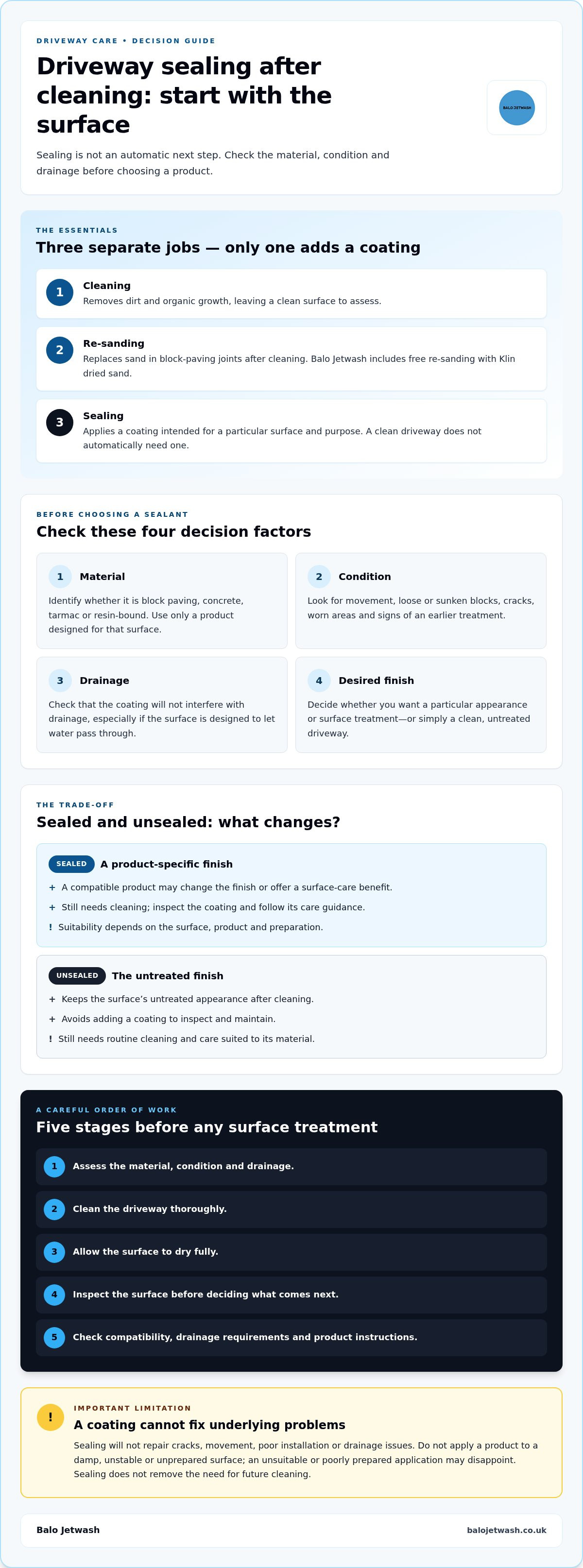
It helps to distinguish between three separate jobs. Cleaning removes dirt and organic growth. Re-sanding replaces sand in block-paving joints after cleaning. Balo Jetwash includes free re-sanding with Klin dried sand as part of its driveway cleaning. Sealing applies a coating intended for a particular surface and purpose. Completing one step doesn’t mean the next is necessary.
A bright, clean appearance doesn’t confirm that a driveway is dry, sound or compatible with sealant. A coating won’t correct loose or sunken blocks, cracks or drainage problems. Address those issues before considering a surface treatment. For the cleaning stage, explore professional driveway pressure washing.
What does driveway sealing do after cleaning?
Sealing means applying a product that forms a layer on, or penetrates into, a surface. The term covers different products and methods, so it doesn’t describe one universal treatment. Sealcoating, or pavement sealing, is a broad overview of the practice, not proof that every driveway material benefits from the same approach.
Depending on the product and surface, a sealant may change the finish or provide a particular type of surface care. Results vary, and a coating doesn’t replace routine cleaning or repairs. Check the product’s stated purpose and surface compatibility rather than choosing it on appearance alone.
Which driveway details should shape the decision?
Start by identifying the material. Block paving, concrete, tarmac and resin-bound surfaces have different properties, so a product designed for one may be unsuitable for another. In particular, check that a coating won’t interfere with drainage if the surface is designed to let water pass through.
Age and condition matter too. Look for movement, cracks, worn areas and signs of an earlier treatment, as an existing coating may affect whether a new product is appropriate. Then consider your priorities: do you want a particular appearance or surface treatment, or simply a clean driveway? Before applying anything, check the product instructions for compatibility, drainage requirements and preparation.
Sealed vs unsealed driveways: compare the real trade-offs
A sealant may change a driveway’s appearance or provide surface-care benefits, but the result depends on the material and product. Leaving a driveway unsealed avoids adding a coating, although the surface still needs cleaning and care appropriate to its material. Compare the practical differences before deciding whether a treatment suits your priorities.
| Consideration | Sealed driveway | Unsealed driveway |
|---|---|---|
| Appearance | A compatible product may change the finish or enhance the surface’s appearance. The result varies by material and product. | Keeps the surface’s untreated appearance after cleaning, though weather and use can affect how it looks over time. |
| Upkeep | Still needs cleaning. You may also need to inspect the coating and follow product guidance for ongoing care. | Needs routine cleaning and care suited to its material, but there’s no added coating to maintain. |
| Suitability | Only appropriate where the product is compatible with the surface and its drainage needs. | Can be the straightforward choice if a suitable product is unclear or you’re happy with the clean, untreated finish. |
| Limitations | Won’t fix damage or drainage issues, and an unsuitable or poorly prepared application may disappoint. | Doesn’t provide any product-specific surface-care effect that a compatible sealant might offer. |
Potential benefits: what sealing may help with
Some products are intended to alter a surface’s appearance or provide a layer of surface care. Whether that’s useful depends on the driveway material, the product’s intended use and correct preparation. For example, a glossy or enhanced finish won’t necessarily suit every surface or owner.
A sealant may offer a surface-specific benefit, but it can’t guarantee a particular appearance or level of protection. Read the product directions and decide whether the possible result is worth the extra treatment and care.
Limitations: when sealing may not be the right choice
Pause if the surface is damaged, unstable, damp or not prepared as the product requires. Sealing won’t correct movement, cracks, poor installation or drainage problems. Applying a coating over unresolved issues may hide their appearance without resolving the underlying cause.
Sealing also doesn’t remove the need for future cleaning. Depending on the product, you may need to monitor the finish and follow further care instructions. Base your decision on the surface and your priorities, rather than assuming a sealed driveway is always easier to maintain. For a fresh starting point, explore professional driveway pressure washing.
Does your driveway material suit sealing after cleaning?
There’s no single sealing rule for every driveway. Block paving, concrete, resin-bound surfaces and tarmac have different finishes and construction, so a sealant suitable for one may be unsuitable for another. Identify the surface first, then consider its condition, drainage and any previous treatment. Don’t choose a product just because the driveway looks freshly cleaned.
| Surface | What to check after cleaning | Sealing decision |
|---|---|---|
| Block paving | Check the blocks, joints and any existing treatment. | Verify suitability for the paving and jointing material in the product instructions. |
| Concrete | Look at the finish, condition and signs of an earlier coating. | Use only guidance that specifically covers the concrete surface and finish. |
| Resin-bound | Consider the surface condition and how it is designed to manage water. | Check that a treatment is compatible with the surface and its drainage function. |
| Tarmac and other surfaces | Identify the exact material and note any worn, loose or previously treated areas. | Don’t assume a general-purpose product is suitable; verify against surface-specific directions. |
Check material and performance claims against the product instructions and reliable guidance for that exact surface. The table is a starting point, not a product recommendation. If you can’t identify an earlier coating, or the surface is damaged or loose, pause before applying another layer. Sealant won’t repair cracks, stabilise moving sections or resolve drainage problems.
Block paving, joints and re-sanding
Block paving has joints that may need suitable sand replenished after cleaning. Balo Jetwash includes free re-sanding with Klin dried sand as part of its driveway cleaning. Re-sanding fills joints; sealing is a separate treatment. Neither replaces the other, and whether a sealant is appropriate still depends on the paving, its condition and the product directions. For cleaning and re-sanding as a practical first step, see our driveway pressure-washing service.
Concrete, resin-bound and other surfaces
For concrete, resin-bound paving, tarmac or another surface, check the precise material and finish before deciding. Previous coatings can affect whether a new product is suitable. Loose areas, visible damage or drainage concerns are reasons to address the surface before proceeding. Pay particular attention to any stated drainage requirements, and follow the product’s preparation and compatibility guidance rather than assuming a sealant used on one driveway will work on another.
Keep the decision grounded: identify the material, note its condition and previous treatment, then match those details to reliable product guidance. If the product directions don’t establish suitability for your surface, don’t guess.
How to prepare a driveway before considering sealant
Good preparation helps you assess whether sealing is appropriate. Work through the steps in order: assess the surface, clean it, let it dry, inspect it closely, then follow the sealant manufacturer’s directions. A driveway that looks clean may still hold moisture or have loose material, so appearance alone isn’t a reliable readiness check.
Readiness depends on the driveway surface and the sealant product instructions, not on a fixed drying time. Weather, shade, airflow and the surface condition can all affect drying. Follow the manufacturer’s guidance rather than assuming the same number of hours or days will suit every driveway.
After cleaning: drying and surface checks
Once cleaning is complete, allow the driveway to dry as directed for the product you’re considering. Damp patches, moisture in joints or leftover debris can affect whether the surface is ready. If the instructions require a clean, dry surface, check the whole area, not just the section that gets the most exposure.
Then inspect the driveway closely. Look for loose blocks, worn or missing jointing, cracks and uneven areas that may need attention. Note any previous coatings, as these can affect compatibility. Don’t use sealant to cover a problem: deal with damage or movement before considering an application.
Before applying any driveway sealant
Read the full product label and instructions before starting. Check that the sealant is intended for your driveway material, then follow its directions for cleaning, preparation, drying and application conditions. Don’t assume instructions for block paving also apply to concrete, resin-bound paving or another surface.
Plan access as well. Keep people and vehicles away for the period and in the manner specified by the manufacturer, including any directions about curing. If the instructions aren’t clear for your surface or existing treatment, pause rather than guessing.
Cleaning is the practical first step, whether or not you decide to seal afterwards. Balo Jetwash uses modern, vanbuilt industrial-grade equipment for driveway cleaning. Explore our driveway pressure-washing service to get the surface clean before deciding on further care.
Make your post-cleaning driveway decision with confidence
Sealing may be worth considering if your driveway material is compatible with a suitable product, the surface is in sound condition and the potential finish or care benefits matter to you. If the driveway looks clean and you’re happy with its appearance, a thorough clean may be all you need. Cleaning doesn’t have to be followed by another treatment.
A simple checklist for deciding whether to seal
Before moving ahead, work through these checks:
Material: Have you identified the driveway surface and found product guidance that specifically covers it? Condition: Are there loose blocks, worn joints, cracks, movement or drainage concerns to address first? Priorities: Would the possible change in appearance or surface care be valuable enough to justify extra upkeep? Preparation: Is the surface clean and dry as the product directions require? Instructions: Are compatibility, preparation, application conditions and access guidance clear?
If any answer is uncertain, pause before applying sealant. A coating won’t repair damage or solve drainage problems, and an unsuitable product can produce a result that doesn’t meet expectations. Follow the manufacturer’s directions for the specific driveway rather than relying on a general rule.
Start with a thorough clean
A professional clean gives you a clearer view of the driveway’s material and condition, making it easier to decide whether further care is appropriate. Balo Jetwash uses modern, vanbuilt industrial-grade equipment and includes free licensed industrial cleaning detergent with driveway cleaning. For block paving, free re-sanding with Klin dried sand is also included. Re-sanding replenishes suitable joints; it isn’t a sealant and doesn’t replace one.
So, is sealing a driveway after cleaning worthwhile? It can be when the surface, product and your priorities align. Otherwise, enjoy the refreshed finish and keep the surface maintained with suitable cleaning. If cleaning is your next step, explore driveway pressure washing or request a free, no-obligation quote.
Choose the right next step for your driveway
Sealing isn’t an automatic follow-up to cleaning. It may suit a driveway when the material and condition are appropriate, the product is compatible and its possible benefits are worth the extra care. If you’re happy with the refreshed surface, a thorough clean may be enough.
Before deciding, check the driveway’s material, look for damage or drainage concerns, and follow the sealant manufacturer’s preparation and drying instructions. A clean appearance alone doesn’t confirm the surface is ready, and a coating won’t repair underlying problems.
A great result starts with a thorough clean. Balo Jetwash includes free re-sanding with Klin dried sand and free licensed industrial cleaning detergent with driveway cleaning. Ready to refresh your driveway first? Explore driveway pressure washing and request a free, no-obligation quote.
Frequently Asked Questions
Is it worth sealing a driveway after cleaning?
It depends on the driveway material, condition, drainage and the finish you want. A suitable sealant may be worth considering for a sound surface if its stated benefits matter to you. Sealing isn’t essential after every clean, and it won’t repair cracks, loose sections or drainage problems. Check that the product is intended for your surface before deciding.
Can you seal a driveway straight after pressure washing?
Don’t apply sealant straight after pressure washing unless the product instructions confirm the surface is ready. Cleaning can leave moisture in the surface or joints, and debris or loose material may need attention. Check that the driveway meets the product’s cleanliness and dryness requirements, then inspect it for damage. A fresh appearance is encouraging, but it doesn’t prove the surface is ready for a coating.
How long should a driveway dry before sealing?
There isn’t one drying period that suits every driveway and sealant. Drying depends on the surface, weather and site conditions, while each product may set out its own requirements. Follow the manufacturer’s instructions and make sure the whole area, including relevant joints, meets them before applying anything. Don’t rely on a fixed number of hours or days, or judge readiness by appearance alone.
Does sealing block paving stop weeds from growing?
Sealing shouldn’t be treated as a guarantee that weeds will stop growing in block paving. Suitability and any effect depend on the paving, its joints and the specific product. Re-sanding and sealing are separate steps: suitable sand replenishes joints, while sealant is a separate surface treatment. Keep the paving clean and follow care guidance for its material. Address worn or missing jointing before considering a sealant.
Does driveway sealing make cleaning easier?
A compatible sealant may affect how a surface is cared for, but easier cleaning isn’t guaranteed for every driveway. The outcome depends on the material, product and application, so check what the manufacturer says about cleaning and ongoing maintenance. Sealed surfaces still need attention, and a coating won’t remove existing dirt or fix damage. Weigh the product’s stated benefits against the preparation and upkeep before deciding.
Should all driveway materials be sealed after cleaning?
No. Block paving, concrete, resin-bound surfaces and tarmac have different characteristics, so one sealant won’t suit them all. Check product guidance for your exact surface, finish and drainage needs. Consider the driveway’s condition and any previous treatment, which may affect suitability. If the directions don’t clearly cover your surface, don’t assume it’s compatible. A thorough clean may be all your driveway needs.
What is the difference between re-sanding and sealing a driveway?
Re-sanding replenishes suitable sand in block-paving joints; sealing applies a separate product to or into a surface. They serve different purposes and aren’t interchangeable. Balo Jetwash includes free re-sanding with Klin dried sand and free licensed industrial cleaning detergent with driveway cleaning. Re-sanding isn’t sealing, and it doesn’t mean a sealant is needed. Consider further treatment separately, based on the paving and product directions.
{"@context":"https://schema.org","@type":"FAQPage","mainEntity":[{"@type":"Question","name":"What does driveway sealing do after cleaning?","acceptedAnswer":{"@type":"Answer","text":"Sealing means applying a product that forms a layer on, or penetrates into, a surface. The term covers different products and methods, so it doesn’t describe one universal treatment. Sealcoating, or pavement sealing, is a broad overview of the practice, not proof that every driveway material benefits from the same approach. Depending on the product and surface, a sealant may change the finish or provide a particular type of surface care. Results vary, and a coating doesn’t replace routine cleaning or repairs. Check the product’s stated purpose and surface compatibility rather than choosing it on appearance alone."}},{"@type":"Question","name":"Which driveway details should shape the decision?","acceptedAnswer":{"@type":"Answer","text":"Start by identifying the material. Block paving, concrete, tarmac and resin-bound surfaces have different properties, so a product designed for one may be unsuitable for another. In particular, check that a coating won’t interfere with drainage if the surface is designed to let water pass through. Age and condition matter too. Look for movement, cracks, worn areas and signs of an earlier treatment, as an existing coating may affect whether a new product is appropriate. Then consider your priorities: do you want a particular appearance or surface treatment, or simply a clean driveway? Before applying anything, check the product instructions for compatibility, drainage requirements and preparation. A sealant may change a driveway’s appearance or provide surface-care benefits, but the result depends on the material and product. Leaving a driveway unsealed avoids adding a coating, although the surface still needs cleaning and care appropriate to its material. Compare the practical differences before deciding whether a treatment suits your priorities."}},{"@type":"Question","name":"Is it worth sealing a driveway after cleaning?","acceptedAnswer":{"@type":"Answer","text":"It depends on the driveway material, condition, drainage and the finish you want. A suitable sealant may be worth considering for a sound surface if its stated benefits matter to you. Sealing isn’t essential after every clean, and it won’t repair cracks, loose sections or drainage problems. Check that the product is intended for your surface before deciding."}},{"@type":"Question","name":"Can you seal a driveway straight after pressure washing?","acceptedAnswer":{"@type":"Answer","text":"Don’t apply sealant straight after pressure washing unless the product instructions confirm the surface is ready. Cleaning can leave moisture in the surface or joints, and debris or loose material may need attention. Check that the driveway meets the product’s cleanliness and dryness requirements, then inspect it for damage. A fresh appearance is encouraging, but it doesn’t prove the surface is ready for a coating."}},{"@type":"Question","name":"How long should a driveway dry before sealing?","acceptedAnswer":{"@type":"Answer","text":"There isn’t one drying period that suits every driveway and sealant. Drying depends on the surface, weather and site conditions, while each product may set out its own requirements. Follow the manufacturer’s instructions and make sure the whole area, including relevant joints, meets them before applying anything. Don’t rely on a fixed number of hours or days, or judge readiness by appearance alone."}},{"@type":"Question","name":"Does sealing block paving stop weeds from growing?","acceptedAnswer":{"@type":"Answer","text":"Sealing shouldn’t be treated as a guarantee that weeds will stop growing in block paving. Suitability and any effect depend on the paving, its joints and the specific product. Re-sanding and sealing are separate steps: suitable sand replenishes joints, while sealant is a separate surface treatment. Keep the paving clean and follow care guidance for its material. Address worn or missing jointing before considering a sealant."}},{"@type":"Question","name":"Does driveway sealing make cleaning easier?","acceptedAnswer":{"@type":"Answer","text":"A compatible sealant may affect how a surface is cared for, but easier cleaning isn’t guaranteed for every driveway. The outcome depends on the material, product and application, so check what the manufacturer says about cleaning and ongoing maintenance. Sealed surfaces still need attention, and a coating won’t remove existing dirt or fix damage. Weigh the product’s stated benefits against the preparation and upkeep before deciding."}},{"@type":"Question","name":"Should all driveway materials be sealed after cleaning?","acceptedAnswer":{"@type":"Answer","text":"No. Block paving, concrete, resin-bound surfaces and tarmac have different characteristics, so one sealant won’t suit them all. Check product guidance for your exact surface, finish and drainage needs. Consider the driveway’s condition and any previous treatment, which may affect suitability. If the directions don’t clearly cover your surface, don’t assume it’s compatible. A thorough clean may be all your driveway needs."}},{"@type":"Question","name":"What is the difference between re-sanding and sealing a driveway?","acceptedAnswer":{"@type":"Answer","text":"Re-sanding replenishes suitable sand in block-paving joints; sealing applies a separate product to or into a surface. They serve different purposes and aren’t interchangeable. Balo Jetwash includes free re-sanding with Klin dried sand and free licensed industrial cleaning detergent with driveway cleaning. Re-sanding isn’t sealing, and it doesn’t mean a sealant is needed. Consider further treatment separately, based on the paving and product directions."}}]}
Information
Water available? - You don't need to be present for us to carry out the service. If required, we can supply water ourselves.
Insurance
Balo Jetwash is fully insured, We have £5,000,000 of public liability insurance. Balo Jetwash operatives are professional, reliable and endeavour to carry out the work to the highest standard with minimal fuss and upheaval.