
Conservation area exterior cleaning in Mere Green: permission

Routine cleaning of existing exterior surfaces in a conservation area generally doesn’t need planning permission. For a property in Sutton Coldfield, the exact address and scope of work matter: listed buildings have separate, stricter controls that may affect cleaning methods.
It’s understandable to want clarity before work begins, especially where historic materials or original details could be affected. The key is to distinguish routine cleaning from changes to a building and choose a method suited to its surfaces.
This article explains when permission may be needed, how cleaning methods vary by material, and what to discuss with a conservation-aware contractor. You’ll also learn how listed status and property-specific restrictions can shape the work, helping you plan the next step with care.
Key Takeaways
Routine cleaning of existing exterior surfaces in a conservation area generally doesn’t need permission, but listed-building controls are stricter. Article 4 Directions can restrict certain external changes, so distinguish washing from work that alters a property’s appearance. Check whether the property is listed and whether restrictions apply before planning work beyond routine cleaning. Choose a cleaning approach that suits the material: softer masonry may call for gentler methods than high-pressure washing. A conservation-aware contractor should explain the proposed method, surface risks and how the work will protect historic details.Listed buildings and conservation areas
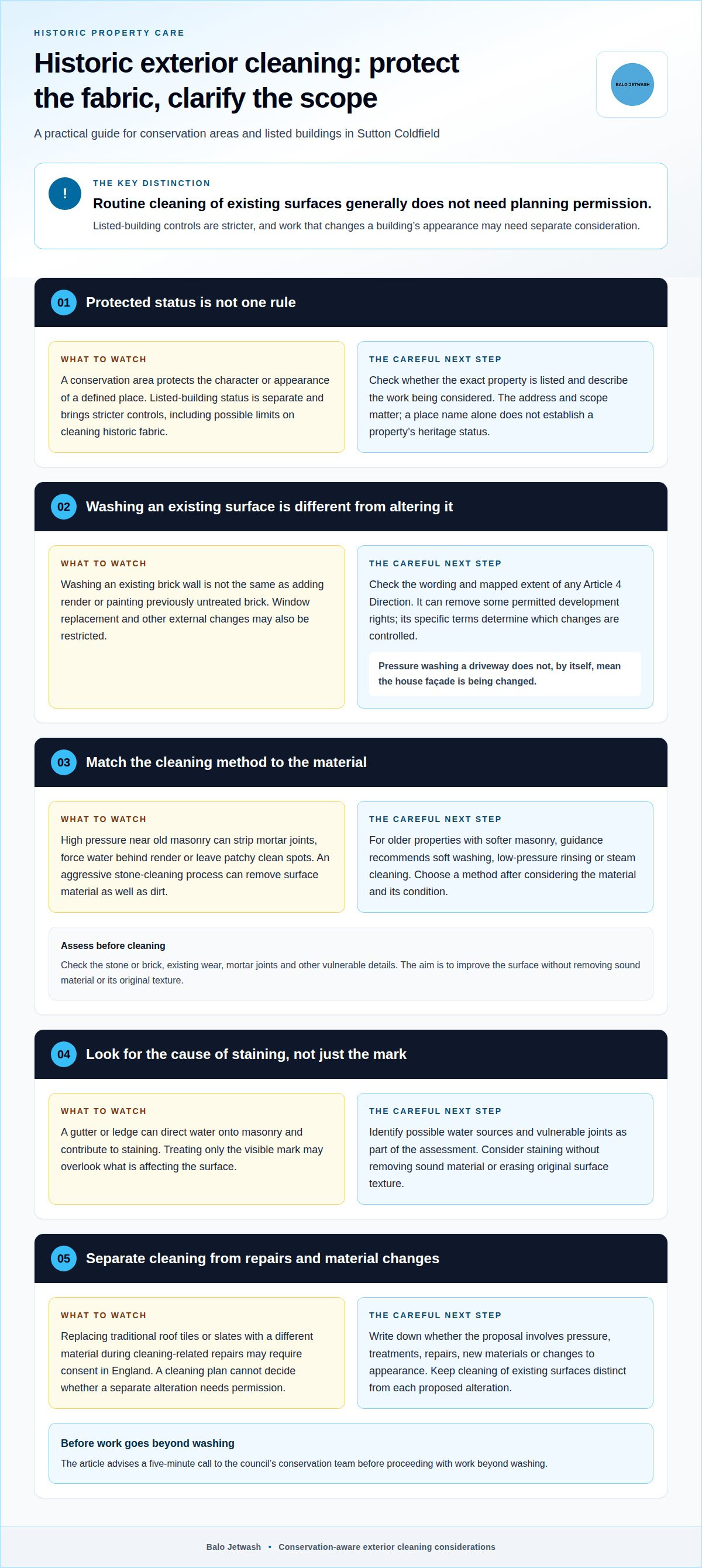
A conservation area protects the character or appearance of a defined place. Listed-building status is separate and brings stricter controls, including possible limits on cleaning historic fabric. Routine cleaning of existing roofs, render or brickwork generally doesn’t require permission. However, washing an existing surface differs from replacing materials or changing its appearance. A deep clean should account for original details, mortar joints and decorative features.
Under subsection (1), UK Parliament states that special attention shall be paid to the desirability of preserving or enhancing a conservation area’s character or appearance when the relevant functions are exercised. This principle matters when deciding how exterior work may affect a protected place. It doesn’t mean every cleaning task needs consent, but it does make the effect on the area’s character relevant to decisions about works.
For older properties with softer masonry, guidance recommends soft washing, low-pressure rinsing or steam cleaning. The method should match the material and its condition. Soft stone, aged brick and mortar may react differently to pressure, so a technique suitable for one wall may harm another. Before work begins, the surface should be assessed, vulnerable joints identified and staining considered without removing sound material.
Incorrect cleaning can damage historic fabric. High pressure near old masonry can strip mortar joints, force water behind render or leave patchy clean spots. Listed-building controls may also apply to cleaning methods. Repairs that change materials raise a separate concern: replacing traditional roof tiles or slates with a different material during cleaning-related repairs may require consent in England.
Stone cleaning needs particular care because an aggressive process can remove surface material along with dirt. Assessment should consider the stone, existing wear and vulnerable joints before selecting a treatment. A gutter or ledge may direct water onto masonry and contribute to staining, so identifying the source can help shape the cleaning plan. The aim is to improve the surface without erasing its original texture.
For homeowners in Sutton Coldfield or Wolverhampton, first establish whether the property is listed and whether the planned work goes beyond cleaning existing surfaces. If a project includes repairs or material changes, seek relevant conservation advice before proceeding. These place names don’t establish the heritage status of a particular address; protection depends on the property and its designation.
A useful first step is to describe the work precisely: cleaning existing stone differs from replacing roof materials or changing a façade. Record whether the proposal involves pressure, treatments or repairs. That distinction gives Balo Jetwash a clear scope and helps identify when cleaning is only one part of a wider project. A careful assessment can protect historic details while keeping the work focused.
The Civic Amenities Act 1967 empowered local authorities to designate areas considered special as conservation areas. UK Parliament says the Planning (Listed Buildings and Conservation Areas) Act 1990 allows local authorities to remove householders' permitted development rights where necessary. A five-minute call to the council's conservation team is advised before work beyond washing proceeds.
Article 4 Directions
An Article 4 Direction can remove some permitted development rights for properties in a conservation area in England. It may restrict external changes such as replacing windows with uPVC or rendering exposed brick for the first time. The restriction concerns changes to a building’s appearance, not automatically every routine cleaning task. Keep that distinction clear when planning work on a house in Sutton Coldfield.
For example, washing an existing brick wall is different from applying render that changes its finish. Painting previously untreated brick may also require consent under an Article 4 Direction because it alters the building’s appearance. Pressure washing a driveway does not itself mean the house façade is being changed, but a wider project that includes new materials or finishes needs separate consideration.
Before arranging work, identify exactly what the proposal includes. Is it limited to washing an existing surface, or does it include painting, rendering, window replacement or other alterations? Record the materials involved and the areas affected. This gives the local planning authority a clear description of the proposed work and helps distinguish cleaning from a change that an Article 4 Direction may control.
Look at the wording and mapped extent of the Direction for the property, rather than assuming every conservation-area address has identical restrictions. The specific Direction determines which permitted development rights have been removed. If a driveway project also involves a new surface or a change to the front boundary, describe those elements separately from cleaning. A cleaning plan cannot determine whether an alteration needs permission.
Surface maintenance still needs care. On block paving, pressure washing can affect jointing sand, so the method should suit the paving and its condition. A vacuum may help collect loose debris during some cleaning work, but equipment choice doesn’t replace planning checks for proposed changes. A good result starts with a precise scope: clean the existing surface, identify any repair, and separate each proposed alteration.
For homeowners in Sutton Coldfield, the practical sequence is straightforward: establish whether an Article 4 Direction covers the property, compare the proposed work with the restrictions, then clarify any consent requirements before alterations begin. That matters especially if the project combines cleaning with painting untreated brick or adding render. Describing a job as “exterior cleaning” does not make an appearance-changing element routine washing.
Keep the cleaning brief specific. Name the surface, its current finish and the treatment proposed; note whether the work includes pressure washing, new materials or changes to joints. If the scope is limited to cleaning existing surfaces, say so plainly. If it includes an alteration, treat that as a separate planning question. This distinction helps protect the building’s character and prevents cleaning work from expanding into a different project.
Describing a project accurately also matters in Sutton Coldfield conservation areas, where planning permission is needed to build small extensions or driveways. Permission is also needed for specified roof works, including adding roof windows, aerials, satellite dishes, solar panels or wind turbines. It is also needed to demolish any part of a building or wall.
Choosing a conservation-aware contractor
For conservation-area-approved exterior cleaning in Wolverhampton, a useful starting point is a clear written brief. Name the building surface, the visible problem and the finish you want to retain. Include details such as previous repairs, peeling coatings or areas that have already been cleaned. This helps Balo Jetwash assess the job before proposing a method, rather than relying on a broad description such as “clean the exterior”.
Ask for the proposed work to be explained in plain language. A sound assessment distinguishes the treatment from the result: removing loose growth, for instance, is different from promising to erase every mark. The cleaning professional should describe what the process aims to improve and identify surface features that may affect the finish. Clear limits show realistic planning, not a lack of care.
Before agreeing to the work, look for practical details in the proposal:
The surfaces and specific areas included in the job. How the contractor will protect nearby features and planting. What preparation, cleaning and final clearing the work involves. How access, water use and runoff will be managed. What the contractor will do if the surface responds unexpectedly.A site visit can reveal issues that photographs miss. Uneven staining, loose pointing, repaired sections and limited access may change how the job should be planned. The cleaning professional should note these observations and explain whether they affect the proposed scope. For a narrow entrance beside delicate detailing, for example, protection and controlled application may matter as much as the treatment.
Check that the quotation reflects the discussion. If it names only a general service, ask for the affected surfaces and included tasks to be made clear in writing. That makes it easier to distinguish agreed cleaning from later repairs or additional work. Keep any planning correspondence or property information with the written scope, so everyone shares the same understanding.
Professional conduct also shows in how the work is organised. A contractor should explain who will carry out the job, how access will be managed and how the area will be left afterwards. For shared entrances or a commercial frontage, agree how people will be kept clear of the working area. These practical arrangements help avoid confusion on the day.
Choose based on the quality of the assessment, not the boldness of a promise. A useful proposal connects the surface, its condition and the planned treatment, while setting out what the work covers. When those details are understood beforehand, you can make a more informed decision and keep the cleaning brief focused on the property’s needs.
The method should be chosen after assessing the specific surface and its condition. The cleaning professional should explain the treatment, protect nearby features and use controlled application where delicate detailing requires it.
Is the property in a conservation area?
A neighbourhood name alone doesn’t establish whether a particular property sits within a conservation area. Designated boundaries apply to defined places, so the answer depends on the property’s exact address and position. For a home in Sutton Coldfield, check the relevant planning records rather than relying on an area name, estate description or a nearby property’s status.
Start with the full address, including the street and postcode. Use the council’s conservation-area map or planning records to locate the property against the designated boundary. A boundary may run through or beside a street, so neighbouring homes can have different statuses. Confirm whether the house and any land included in the proposed work fall within the mapped area.
Keep conservation-area status separate from listed-building status. A conservation area covers a defined place, while listing applies to an individual building. A property may be in a conservation area without being listed, and the designations can also overlap. For example, two nearby houses may be subject to different controls because their designations or positions differ.
If the map is difficult to read at property level, use the council’s planning enquiry route and provide the complete address. Ask whether the building or relevant land lies inside the boundary, and keep the response with the project details. This is especially useful when a cleaning proposal covers more than one part of the property, such as a house façade and a front boundary wall.
Make the enquiry specific. State whether the proposed work is limited to cleaning an existing surface or includes repairs, replacement materials or a change in finish. Those distinctions help the planning team consider the right issue. A general question about “exterior work” may leave uncertainty about the surface or alteration being discussed.
For homeowners in Sutton Coldfield, an address-based check also helps distinguish local terminology from formal designation. An area name may describe a place broadly, but that label doesn’t establish a conservation boundary. Likewise, being near a designated place doesn’t prove that a house is included. The property’s mapped position is the key detail.
Before arranging work, keep a short record of the address, the surfaces involved and any planning response. Share those details with Balo Jetwash so the cleaning scope reflects the property’s location and status. This gives everyone a clearer starting point, particularly if the job combines surface cleaning with repairs or alterations that may need separate consideration.
What cleaning methods are acceptable for historic buildings in Sutton Coldfield conservation areas?
For older buildings with softer masonry, soft washing, low-pressure rinsing and steam cleaning are recommended approaches. The suitable choice depends on the actual material and its condition. Soft sandstone, aged brick and lime mortar can respond differently, so a method suitable for one wall may not suit another. “Acceptable” describes a careful cleaning approach, not automatic planning approval for every property or project.
Low-pressure rinsing reduces the force directed at fragile surfaces. High-pressure washing close to old masonry can strip mortar joints, drive water behind render or create patchy clean spots. For example, a soft stone façade with weathered joints needs a different assessment from robust modern paving. Pressure alone doesn’t determine the outcome: distance, water flow, surface wear and the operator’s control also matter.
Soft washing uses a cleaning treatment rather than relying on force alone. On historic brick or stone, the material should first be identified and assessed for how it may react. Aged mortar, flaking surfaces and previous repairs can all affect the choice. The treatment must suit the surface; a stronger product isn’t automatically more effective or appropriate for removing staining.
Steam cleaning may suit some older masonry, but it still requires a surface-specific approach. Consider existing cracks, loose pointing and areas where water could enter. Historic buildings often contain repairs made with different materials, so one wall can have several areas with different vulnerabilities. The method should account for those differences rather than treating the façade as uniform.
A careful professional process can follow these steps:
Identify whether the surface is brick, stone, render or a combination. Inspect mortar joints, previous repairs, cracks and loose material. Choose soft washing, low-pressure rinsing or steam based on that assessment. Agree the work area and protect nearby vulnerable details. Review the cleaned surface and adjust the approach if its response changes.For a Sutton Coldfield property, the brief should identify the exact surface and its condition. “Clean the front” gives less useful direction than “remove surface growth from the older brick façade, avoiding the soft mortar joints”. That detail helps explain why a method suits the material. It also separates masonry cleaning from driveway cleaning, which may need different equipment and handling.
Don’t assume the strongest pressure will deliver the best finish. On old brickwork, it can remove sound material along with dirt; on render, water may be forced behind the surface. Discuss the intended method, likely surface response and areas needing extra care before work begins. A measured treatment can improve appearance while respecting the building’s historic fabric.
Balo Jetwash: exterior cleaning
Balo Jetwash provides professional cleaning for exterior surfaces, including driveways and patios. For a conservation-area property, share the surface type and any known heritage restrictions when describing the work. The cleaning method depends on the material, its condition and the risk of damage, so the proposed scope should focus on the surface needing attention.
A paved entrance and a soft historic wall, for example, need different approaches. If you’re planning cleaning at a property in Wolverhampton, contact Balo Jetwash to discuss the work.
Plan the next step with care
Before arranging conservation-area-approved exterior cleaning in Sutton Coldfield, make the work scope clear. Note the surface, its condition and the cleaning requested. Keep cleaning separate from repairs or material changes, so each part can be considered on its own.
Balo Jetwash provides driveway and patio cleaning. If you’re considering one of these services, share the property details and the area you want cleaned. That gives the team a useful starting point for discussing the work and a surface-specific approach.
Ready to talk through your exterior cleaning plans? Contact Balo Jetwash about exterior cleaning. A clear brief is a simple first step towards making your property look cared for while respecting its character.
Frequently Asked Questions
Do you need permission to hire a contractor to clean your house?
No, you don’t need planning permission simply to hire a cleaning professional. Routine cleaning of existing exterior surfaces generally doesn’t require permission, including in a conservation area. The key distinction is whether the work only cleans what is already there or also changes the property. For example, adding render or painting previously untreated brick can raise separate planning considerations. Listed-building status can also bring stricter controls over cleaning methods.
Does exterior cleaning require planning permission in a conservation area in England?
Routine cleaning of an existing surface generally doesn’t require planning permission in an English conservation area. Washing a wall differs from changing its finish, replacing materials or altering its appearance. An Article 4 Direction can restrict certain external changes, such as rendering exposed brick for the first time. Listed buildings have separate, stricter controls. Before combining cleaning with repairs or alterations, establish whether those additional works need consent.
{"@context":"https://schema.org","@type":"FAQPage","mainEntity":[{"@type":"Question","name":"Do you need permission to hire a contractor to clean your house?","acceptedAnswer":{"@type":"Answer","text":"No, you don’t need planning permission simply to hire a cleaning professional. Routine cleaning of existing exterior surfaces generally doesn’t require permission, including in a conservation area. The key distinction is whether the work only cleans what is already there or also changes the property. For example, adding render or painting previously untreated brick can raise separate planning considerations. Listed-building status can also bring stricter controls over cleaning methods."}},{"@type":"Question","name":"Does exterior cleaning require planning permission in a conservation area in England?","acceptedAnswer":{"@type":"Answer","text":"Routine cleaning of an existing surface generally doesn’t require planning permission in an English conservation area. Washing a wall differs from changing its finish, replacing materials or altering its appearance. An Article 4 Direction can restrict certain external changes, such as rendering exposed brick for the first time. Listed buildings have separate, stricter controls. Before combining cleaning with repairs or alterations, establish whether those additional works need consent."}}]}Information
Water available? - You don't need to be present for us to carry out the service. If required, we can supply water ourselves.
Insurance
Balo Jetwash is fully insured, We have £5,000,000 of public liability insurance. Balo Jetwash operatives are professional, reliable and endeavour to carry out the work to the highest standard with minimal fuss and upheaval.